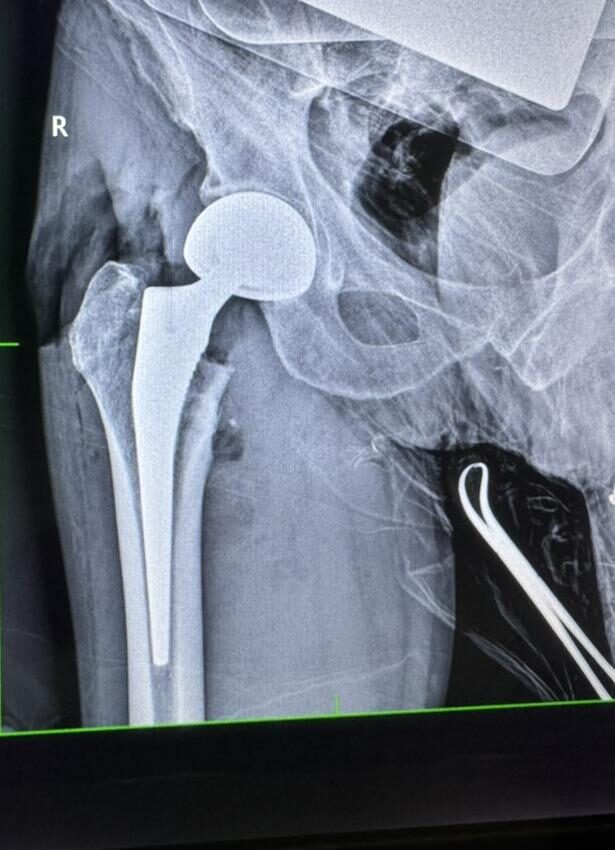
A total hip replacement replaces both worn surfaces of the joint: the femoral head is replaced by a stem with a spherical head, and the acetabulum by a cup with its bearing surface. The goal is not a pretty radiograph — it is to take away the pain and give back the life the hip took from you.
It is one of the highest-yield operations in all of modern medicine, and patient satisfaction is high. But it is major surgery, and it deserves to be explained with real numbers and without promises.
When it is indicated
When pain from arthritis, avascular necrosis, dysplasia or the aftermath of a fracture no longer responds to conservative treatment and limits what you do every day: walking, sleeping, dressing. Also in certain types of hip fracture, where the replacement is the treatment of the fracture rather than an elective decision.
Before operating we have to be sure the pain is coming from the hip. When lumbar spine disease coexists — very common past 60 — it is worth establishing which of the two is generating the current pain, with a diagnostic injection if needed. Operating on the hip of someone whose pain arose in the spine is one of the commonest reasons for dissatisfaction after technically impeccable surgery.
How long a replacement lasts
It is the question every patient asks, and it deserves an honest answer. A systematic review combining clinical series and national arthroplasty registries found that, according to the registries — the least biased source — around 58% of hip replacements are still functioning at 25 years. In the published clinical series the figure was 78%, but registries better reflect the reality of the population.
That number is a population figure, not a personal one. Your case depends on the age at which you are operated on, on your weight and activity level, on the type of implant and on the quality of your bone. A 75-year-old patient will probably never need a second operation. A 50-year-old should expect that they might — but generally not before about twenty years, and that second operation, planned and done in good time, is a very different scenario from a replacement that fails early.
Recovery, realistically
With current techniques, most patients stand and walk with support the same day or the day after. Hospital discharge is usually early. The first weeks are spent working on gait, range of movement and gluteal strength, which is what supports the hip.
The sense of normality returns in stages: many patients put the cane away between the second and sixth week, resume everyday activities within the first month, and keep gaining strength for several months. The final result depends considerably on the physical condition you arrived at surgery with; that is why it is worth preparing the hip before operating on it.
What you will be able to do afterwards
Walk without pain, climb stairs, travel, swim, cycle, dance, drive again. The vast majority of patients return to a completely normal life.
What is discouraged is repeated high-impact loading — long-distance running on asphalt, contact sports — not because it “will break”, but because it accelerates wear of the bearing surface and with that shortens the life of the implant. It is a conversation about priorities, not a list of prohibitions.
Risks you should know about
Every major operation has them, and I would rather state them beforehand than afterwards: infection, venous thrombosis, dislocation of the implant, leg length discrepancy, fracture around the implant and loosening over time. They are uncommon, and much of the risk is reduced by antibiotic prophylaxis, thromboprophylaxis, careful technique and early mobilisation. But they are part of the decision, and you have a right to know them before signing anything.
Dr. Kushner’s approach: a replacement is not "giving up"; it is getting your life back. My aim is to recommend it at the right moment — neither too early nor so late that the patient has lost years of quality of life — and to perform it with a technique that allows a fast recovery.
With a joint replacement in place, these are urgent
- Fever, redness, warmth or discharge from the wound — at any time, even years later.
- Pain that returns after a symptom-free period, or that changes in character.
- A sense that the hip is giving way or slipping when you bear weight.
- Inability to bear weight after a fall, even a minor one: this may be a fracture around the implant.
- Visible shortening of the leg or a change in the way you walk.
Frequently asked questions
How long does a hip replacement last?
Modern implants are very durable; most function for many years. Technique and implant type both matter.
When will I walk?
Most patients stand the same day or the day after, with support, and progress according to their rehabilitation plan.
How long does a hip replacement last?
According to a systematic review combining series and national registries, around 58% of hip replacements are still working at 25 years. That is a population figure: your case depends on age, activity and implant type.
When will I be walking?
In most cases walking with support begins the same day or the day after surgery. Full recovery takes weeks and depends on your prior condition.
What will I not be able to do afterwards?
Most people return to walking, swimming, cycling and travelling without restriction. What is discouraged is repeated high-impact loading, which accelerates wear.
References
- Evans JT, et al. How long does a hip replacement last? A systematic review and meta-analysis of case series and national registry reports with more than 15 years of follow-up. Lancet. 2019;393(10172):647-654. DOI
- Bannuru RR, et al. OARSI guidelines for the non-surgical management of knee, hip, and polyarticular osteoarthritis. Osteoarthritis Cartilage. 2019;27(11):1578-1589. DOI
Book your assessment
Book a consultation with Dr. Kushner at COMEDSA. Bring any previous imaging for a complete assessment.
Educational information reviewed by Dr. Michael Kushner Shrem. It does not replace an in-person medical assessment.