The first task is to determine whether the fracture is stable or unstable: if the ring is broken at a single point it is usually stable; if it is broken in two or more places, the ring loses its integrity and becomes unstable. That distinction defines the whole treatment. Imaging includes radiographs and CT, which shows the pattern precisely.
Stable fractures are usually treated without surgery, with pain control and progressive weight-bearing. Unstable fractures require surgical fixation to restore the shape and stability of the ring, allow mobilisation and prevent sequelae such as chronic pain, limb length discrepancy or difficulty sitting and walking. In the severe acute phase, temporary stabilisation measures (damage control) are sometimes used before definitive surgery.
Dr. Kushner’s approach: a pelvic fracture is a matter of teamwork and precision. My training in pelvis and acetabulum (fellowship in Jerusalem) is dedicated precisely to restoring the anatomy of this complex region, which few surgeons handle.
Cases treated by Dr. Kushner
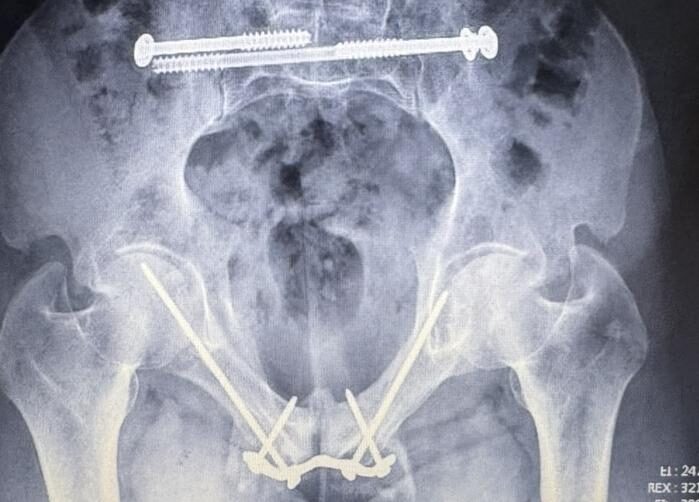
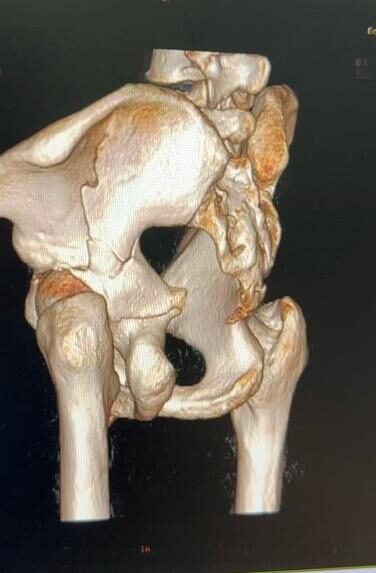
Radiographs from real cases treated by Dr. Kushner (de-identified images, used with consent).
Signs that mean going to the emergency department
- Being unable to bear weight after the injury, or visible deformity of the limb.
- Numbness, loss of strength, or cold or pale toes or fingers below the injury.
- Pain that grows out of proportion and does not respond to analgesia: this may indicate compartment syndrome.
- An open wound over the fractured area.
- Swelling that increases quickly, with tight, shiny skin.
Frequently asked questions
Does every pelvic fracture need surgery?
No. Stable fractures are treated without surgery; unstable ones do require fixation to restore the ring.
Will I walk normally again?
The aim is to restore the anatomy so that walking recovers. The result depends on the fracture pattern and on a precise reconstruction.
Why is this such a serious injury?
Because the pelvic ring houses large vessels and organs. In high-energy trauma the immediate risk is bleeding, and initial management is a team effort, with the patient stabilised before reconstruction is even considered.
Are they all operated on?
No. Stable, undisplaced fractures can be treated without surgery. Those that break the stability of the ring or leave significant displacement are operated on.
Will I walk normally again?
Many patients recover a functional gait, but the pelvis is a serious injury and recovery is long. The result depends on the fracture pattern, on the quality of the reduction and on rehabilitation.
References
- Roszman AD, et al. Management of open pelvic ring injuries. Injury. 2023;54(4):1041-1046. (Review focused on open pelvic ring injuries.) DOI
Book your assessment
Book a consultation with Dr. Kushner at COMEDSA. Bring any previous imaging for a complete assessment.
Educational information reviewed by Dr. Michael Kushner Shrem. It does not replace an in-person medical assessment.