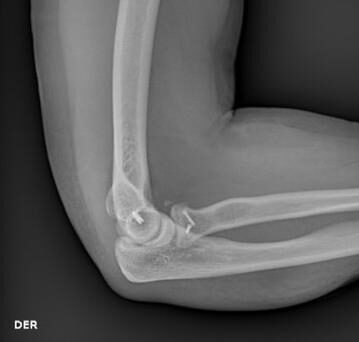
The patient has severe pain, swelling and difficulty moving the elbow. CT is essential to understand the articular pattern and plan the reconstruction.
In most cases the treatment is surgical: reconstructing the articular surface and fixing it stably — usually with plates on both sides — to allow early elbow movement and avoid stiffness, which is the main sequela. In older adults with highly comminuted fractures, a total elbow replacement is sometimes the better functional option. Early, directed rehabilitation is decisive.
Dr. Kushner’s approach: in the elbow, fixation has a single purpose: to allow early movement. A stable reconstruction that permits early rehabilitation is what separates a functional elbow from a stiff one.
Signs that mean going to the emergency department
- Obvious deformity of the wrist, forearm or elbow after the fall.
- Numbness or tingling in the fingers, or difficulty moving them.
- A cold, pale or bluish hand or fingers.
- Pain that increases despite ice, elevation and painkillers.
- An open wound, or swelling that grows quickly with tight skin.
Frequently asked questions
Why is moving the elbow early so important?
Because the elbow stiffens easily. Surgery aims for stable fixation precisely so that rehabilitation can start early.
Will I keep full movement?
The aim is a functional elbow. The result depends on the initial damage and on consistent rehabilitation.
Why does the elbow stiffen?
Because it is a joint that reacts to trauma and immobilisation by stiffening quickly. That is why the surgical goal is firm fixation that allows early movement.
When do I start moving it?
As soon as the fixation allows, often within the first few days. Waiting for the bone to unite before moving usually leaves sequelae.
What about older patients with fragile bone?
In selected cases, with highly comminuted bone, a total elbow replacement may be considered instead of fixation. It is an individual decision.
References
- Schindelar LE, Rondon AJ, Ilyas AM. Total elbow arthroplasty versus open reduction and internal fixation for distal humerus fractures in the elderly. Orthopedics. 2019;42(1):22-27. DOI
Book your assessment
Book a consultation with Dr. Kushner at COMEDSA. Bring any previous imaging for a complete assessment.
Educational information reviewed by Dr. Michael Kushner Shrem. It does not replace an in-person medical assessment.