Symptoms are pain, marked swelling and inability to bear weight after the injury. CT is essential to see the articular depression and to plan; MRI helps when meniscal or ligament injury is suspected.
The principle of treatment is to elevate the depressed surface and support it, restoring a congruent, stable knee. Undisplaced fractures can be treated without surgery; displaced or depressed ones require reduction, structural graft if needed and fixation with plates and screws. The state of the soft tissues largely dictates the timing of surgery.
Dr. Kushner’s approach: the tibial plateau is fought on two fronts: reconstructing the articular surface and respecting the soft tissues. Operating at the right moment, neither early nor late, matters as much as the technique.
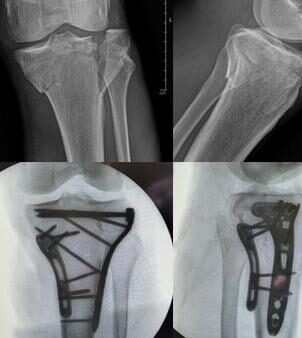
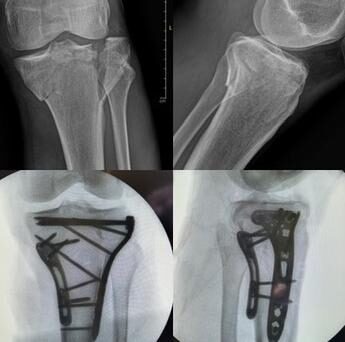
Cases treated by Dr. Kushner
Radiographs from real cases treated by Dr. Kushner (de-identified images, used with consent).
Signs that mean going to the emergency department
- Being unable to bear weight after the injury, or visible deformity of the limb.
- Numbness, loss of strength, or cold or pale toes or fingers below the injury.
- Pain that grows out of proportion and does not respond to analgesia: this may indicate compartment syndrome.
- An open wound over the fractured area.
- Swelling that increases quickly, with tight, shiny skin.
Frequently asked questions
Why is surgery sometimes delayed?
Because the swelling and the condition of the skin have to improve first; operating through compromised soft tissues increases complications.
Will the knee be alright?
The aim is a congruent, stable surface. The prognosis depends on the initial cartilage damage and on a precise reconstruction.
Why does it matter so much that it is perfect?
Because it is weight-bearing cartilage. A residual step in the surface of the knee concentrates pressure and accelerates arthritis years later.
How long without weight-bearing?
Usually several weeks, with early knee mobilisation from the start. The period depends on the pattern and on the fixation.
Is anything else injured besides the bone?
Frequently: menisci and ligaments are damaged in the same impact. That is why imaging includes CT and, where appropriate, MRI.
References
- Softness KA, Murray RS, Evans BG. Total knee arthroplasty and fractures of the tibial plateau. World J Orthop. 2017;8(2):107-114. DOI
Book your assessment
Book a consultation with Dr. Kushner at COMEDSA. Bring any previous imaging for a complete assessment.
Educational information reviewed by Dr. Michael Kushner Shrem. It does not replace an in-person medical assessment.